
Claude now comes in several models, and choosing one can be confusing if you are not familiar with the differences.
You may see Claude Haiku 4.5, Claude Sonnet 5, Claude Opus 5.5, and Claude Fable 5.1 and wonder which one is actually right for your task.
The answer depends less on which model sounds the most powerful and more on what you are trying to accomplish.
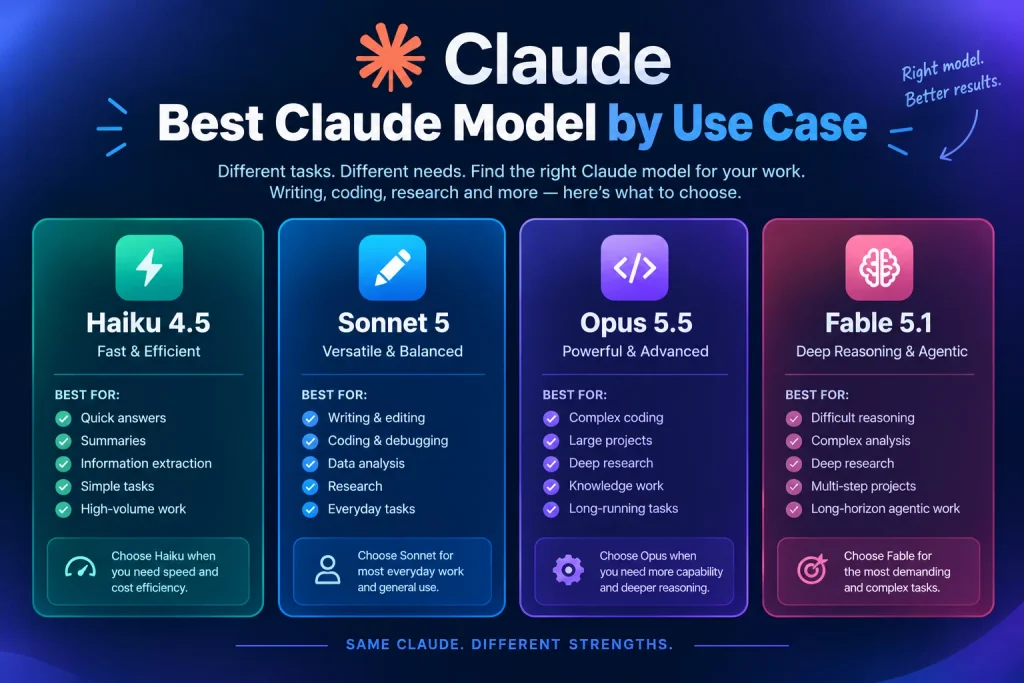
For a quick summary, Haiku is designed for speed and lower cost, Sonnet is a versatile choice for everyday work, Opus is aimed at complex coding and knowledge work, while Fable is intended for demanding reasoning and long-running agentic tasks. Anthropic’s current model documentation also recommends starting with Opus 5.5 for many workloads and moving to Fable 5.1 when the task needs greater reasoning depth or longer autonomous work.
If you are new to Claude, this guide will help you understand what each model is good at and how to choose without simply picking the most expensive option.
Claude Models in 2026

Claude’s current lineup includes four main models:
- Claude Haiku 4.5 — fastest and most cost-efficient
- Claude Sonnet 5 — balanced speed and capability
- Claude Opus 5.5 — designed for complex coding and knowledge work
- Claude Fable 5.1 — built for demanding reasoning and long-horizon agentic work
All four current models support text and image input, text output, multilingual capabilities, vision, and tool use. However, their speed, cost, context limits, and intended workloads are different.
So instead of asking, “Which Claude model is the best?” it is more useful to ask:
“Which Claude model is best for the work I need to do?”
Claude Model Comparison at a Glance
| Claude model | Best suited for | Relative speed | API price per million input/output tokens |
|---|---|---|---|
| Haiku 4.5 | Quick answers, summaries, high-volume tasks | Fastest | $1 / $5 |
| Sonnet 5 | Writing, coding, analysis, everyday workflows | Fast | $2 / $10 |
| Opus 5.5 | Complex coding, research, knowledge work | Moderate | $4 / $20 |
| Fable 5.1 | Difficult reasoning and long-running agentic work | Slower | $10 / $50 |
These are the current API prices listed by Anthropic’s model overview. Consumer Claude plan availability and usage limits are separate from API pricing.
Which Claude Model Should You Use?
There is no single model that makes sense for every task.
Here is a practical way to think about the four options.
Use Claude Haiku 4.5 for Quick and Simple Tasks
Haiku 4.5 is the model to consider when speed and efficiency matter more than maximum reasoning depth.
It can be useful for tasks such as:
- Summarizing an article
- Extracting information from text
- Categorizing content
- Answering straightforward questions
- Rewriting short passages
- Processing large numbers of relatively simple requests
- Real-time applications where response speed matters
Anthropic describes Haiku 4.5 as its fastest model with near-frontier intelligence. The model has a 200K-token context window and supports extended thinking.
For example, if you have a 20-page document and simply want the main points, there may be little reason to use the most expensive model available.
Haiku makes more sense when the task is straightforward, and you need results quickly.
Use Claude Sonnet 5 for Everyday Work
If you are unsure which Claude model to start with, Sonnet 5 is a practical middle ground.
Anthropic describes Sonnet 5 as the combination of speed and intelligence for everyday workloads. Claude Academy also positions Sonnet as a versatile option for writing, coding, analysis, research, and multi-step workflows.
Sonnet can be a good fit for:
- Blog writing and editing
- Content planning
- Coding and debugging
- Data analysis
- Research
- Document work
- Customer-support applications
- Multi-step tasks
- General-purpose AI assistance
For a freelancer or content creator, Sonnet can cover a lot of everyday work without immediately moving to a more expensive model.
For developers, it can also be useful when you need strong coding ability but don’t necessarily need the deepest reasoning available for every request.
Use Claude Opus 5.5 for Complex Coding and Knowledge Work
Claude Opus 5.5 is designed for more demanding work, particularly long-running agentic coding and knowledge-intensive tasks.
Anthropic’s current documentation recommends Opus 5.5 as the starting point for many workloads when capability is important. It has a 1-million-token context window, a maximum output of 128K tokens, and adaptive thinking.
You might consider Opus 5.5 when working on:
- Large software projects
- Complex debugging
- Major code refactoring
- Advanced research
- Complicated analysis
- Long-running agent workflows
- Tasks that require Claude to work through several steps
It is not automatically the right choice for every question.
If you are asking Claude to rewrite a short paragraph, for example, paying for a more capable model may not give you a meaningful advantage.
The point of Opus is to have more capability available when the task actually needs it.
Use Claude Fable 5.1 for the Most Demanding Tasks
Claude Fable 5.1 sits at the high end of the current Claude lineup.
Anthropic describes it as its most capable widely released model and recommends it for demanding reasoning and long-horizon agentic work. It is designed for tasks where Claude may need to work through a complicated problem over a longer period with fewer check-ins.
Fable can make sense for:
- Deep research
- Complex scientific or mathematical work
- Long-running coding agents
- Large multi-step projects
- Detailed analysis
- Complex document creation
- Workflows requiring a high level of autonomy
It is also the most expensive of the four models in the current API lineup.
That means you should not choose Fable simply because it is the most capable model. If Sonnet or Opus can handle your task successfully, using Fable for everything may not be an efficient use of your budget or usage limits.
Which Claude Model Is Best for Writing?
For most everyday writing tasks, Claude Sonnet 5 is a sensible place to start.
It is designed for general workloads and is specifically described by Claude Academy as suitable for writing and content creation.
You could use Sonnet for:
- Blog outlines
- First drafts
- Editing
- Rewriting
- Brainstorming
- Email drafts
- Content summaries
- Research organization
For a more complicated writing project involving extensive research, multiple documents, or a long chain of reasoning, Opus 5.5 or Fable 5.1 may be worth considering.
The important part is not choosing the most powerful model at the beginning. Start with the model that can reasonably handle the job, then move up if you actually need more capability.
Which Claude Model Is Best for Coding?
The answer depends on the complexity of the coding task.
For everyday programming, debugging, code generation, and refactoring, Sonnet 5 can be a practical option. Claude Academy specifically lists coding among Sonnet’s intended uses.
For larger and more complicated software projects, Opus 5.5 is designed for long-running agentic coding and complex systems work.
For especially difficult, long-running coding or agentic tasks where higher reasoning capability is important, Fable 5.1 is the model Anthropic positions at the top of the lineup.
A simple way to think about it:
Small coding task → Sonnet
Complex project → Opus
Very demanding long-running work → Fable
That is a practical starting point rather than a rule that applies to every coding problem.
Which Claude Model Is Best for Research?
For simple research assistance, Sonnet 5 may be enough.
If the research involves complex reasoning, large amounts of information, or a longer multi-step workflow, Opus 5.5 becomes more relevant.
For demanding research that requires extended reasoning and long-running agentic work, Anthropic recommends considering Fable 5.1.
One important point: the model does not remove the need to check important information yourself. For research involving business decisions, technical specifications, current events, or other consequential information, verify important claims against reliable sources.
What About Claude’s Effort and Thinking Settings?
Model choice is not the only thing that affects Claude’s performance.
Some current Claude models support effort settings, which allow you to trade some speed and cost for deeper reasoning within the same model. Anthropic’s model-selection documentation notes that adjusting effort can sometimes be a better option than switching models entirely.
This is useful because you may not need to jump from Sonnet to a more expensive model just because one difficult task produced a weaker result.
For example, you could first try improving your prompt or adjusting the available effort level. If the task still falls short, then testing a more capable model makes more sense.
Does the Most Expensive Claude Model Always Give Better Results?
No.
A more expensive model is not automatically better for every task.
Anthropic’s own guidance recommends evaluating models using your actual prompts and data, then comparing factors such as accuracy, response quality, and performance on edge cases.
This matters especially for developers building AI applications.
A model that performs extremely well on a difficult research task may be unnecessary for a simple classification job. Likewise, a very fast model may be preferable when an application needs thousands of responses and the individual tasks are relatively simple.
The goal is not to find the most powerful model.
The goal is to find the model that handles your particular workload well enough at a reasonable cost and speed.
How to Choose the Right Claude Model
If you are still unsure, use this simple process.
1. Start With the Task
Ask yourself what Claude actually needs to do.
Is it:
- A quick summary?
- Writing?
- Coding?
- Research?
- Data analysis?
- A long-running project?
- A complicated reasoning problem?
The answer will narrow down your choices.
2. Consider Speed
If you need an almost immediate response, Haiku or Sonnet may make more sense.
If you are working on something where response time is less important than depth, Opus or Fable may be worth considering.
3. Consider Cost
Current API pricing ranges from $1/$5 per million input/output tokens for Haiku 4.5 to $10/$50 for Fable 5.1.
That difference becomes important in high-volume applications.
4. Test With Your Real Work
Instead of relying only on model descriptions, take a few real tasks from your workflow and test them.
Compare:
- Accuracy
- Quality
- Speed
- Number of corrections needed
- Cost
- How well the model handles difficult cases
Anthropic recommends this kind of task-specific evaluation when deciding whether to change models.
Which Claude Model Should Beginners Use?
For someone who is just starting with Claude, Sonnet 5 is a reasonable general-purpose starting point, while Haiku 4.5 can be useful for simpler, faster tasks.
You do not need to understand every technical specification before using Claude.
Start with normal tasks such as writing, summarizing, brainstorming, research organization, or basic coding. Once you notice that a task needs more reasoning or is becoming difficult for your current model, move up to Opus or Fable.
This approach also prevents you from using a heavyweight model when a lighter one would have done the job.
Claude Models: Quick Decision Guide
If you want the shortest possible answer:
Choose Haiku 4.5 when:
You need speed, simple processing, summaries, extraction, or high-volume work.
Choose Sonnet 5 when:
You want a versatile model for writing, coding, analysis, research, and everyday tasks.
Choose Opus 5.5 when:
You are dealing with complex coding, large projects, or demanding knowledge work.
Choose Fable 5.1 when:
The task involves very difficult reasoning, deep research, or long-running agentic work.
These recommendations follow Anthropic’s current model descriptions and selection guidance.
Frequently Asked Questions
Which Claude model should I use for everyday tasks?
Claude Sonnet 5 is a practical choice for many everyday tasks because it balances speed and capability. Haiku 4.5 can be preferable when the task is simple and speed or cost is more important.
Which Claude model is best for coding?
For everyday coding, Sonnet 5 is a versatile option. Opus 5.5 is designed for more complex and long-running coding work, while Fable 5.1 is aimed at especially demanding reasoning and agentic tasks.
Is Claude Fable better than Sonnet?
Fable 5.1 is positioned for more demanding reasoning and long-horizon work, while Sonnet 5 is designed as a faster, more efficient general-purpose model. “Better” therefore depends on the task rather than simply the model name.
Is Claude Opus 5.5 worth using?
It can make sense when your work requires complex coding, knowledge work, or longer agentic workflows. For simpler tasks, a faster and less expensive model may be sufficient.
Can I use different Claude models for different tasks?
Yes. Using different models for different workloads can be a practical strategy. Anthropic also documents multi-model approaches where lower-cost models handle routine work while more capable models handle difficult decisions or tasks.
Final Thoughts
Choosing a Claude model does not have to be complicated.
Start by looking at the work in front of you. Haiku 4.5 is built around speed and efficiency. Sonnet 5 is a flexible option for everyday writing, coding, analysis, and research. Opus 5.5 is aimed at more complex coding and knowledge work, while Fable 5.1 is designed for demanding reasoning and long-running agentic tasks.
If you are completely unsure, start with a practical general-purpose option and test it with your real work. Move to a more capable model only when you can identify a genuine need for it.
The right Claude model is not necessarily the one with the biggest price tag. It is the one that can handle your task accurately, efficiently, and at a cost that makes sense for your workflow.