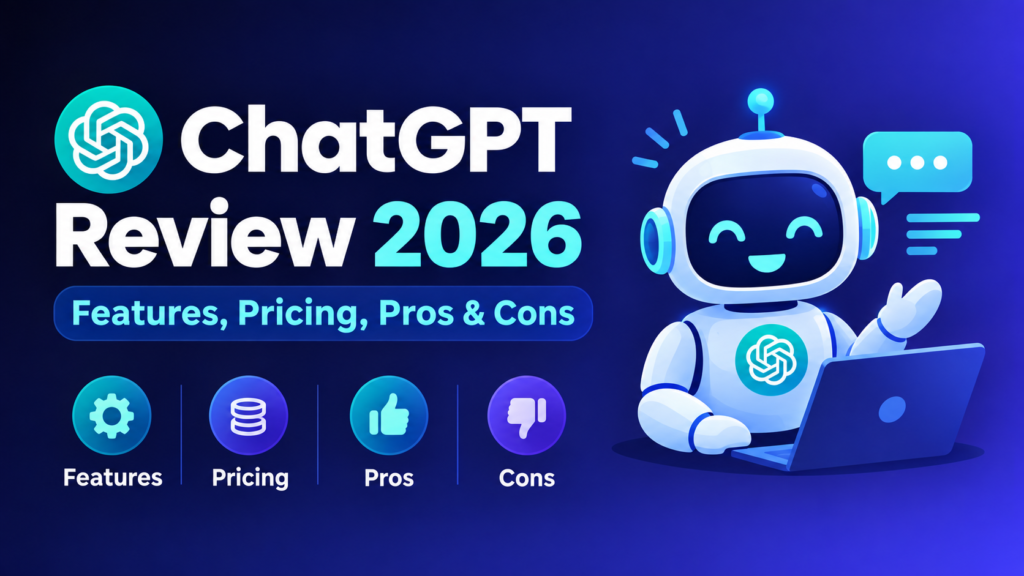
ChatGPT has become one of the most widely used AI assistants for everyday work, learning, writing, research, and productivity. What started mainly as a conversational chatbot can now help with writing, coding, research, file analysis, image-related tasks, and more.
But with so many AI tools available today, is ChatGPT actually useful for everyday users? And do you really need a paid plan to get value from it?
In this ChatGPT review 2026, we look at its main features, pricing, practical uses, advantages, limitations, and business capabilities to help you understand what the tool can realistically do.
What Is ChatGPT?
ChatGPT is an AI assistant developed by OpenAI. It allows users to interact with an AI system using natural-language instructions and follow-up questions.
You can use ChatGPT for tasks such as writing and editing, brainstorming, studying, planning, mathematics, coding, web research, and analyzing supported files and images.
One of the more useful things about ChatGPT is the conversational approach. You can ask a question, review the response, add more information, and request changes without starting the entire task again.
For example, a freelancer could use ChatGPT to draft an email, improve a proposal, brainstorm content ideas, or explain a technical topic.
That said, ChatGPT should be treated as an assistant rather than an unquestionable source of information. Its responses can contain mistakes, so important facts should still be checked.
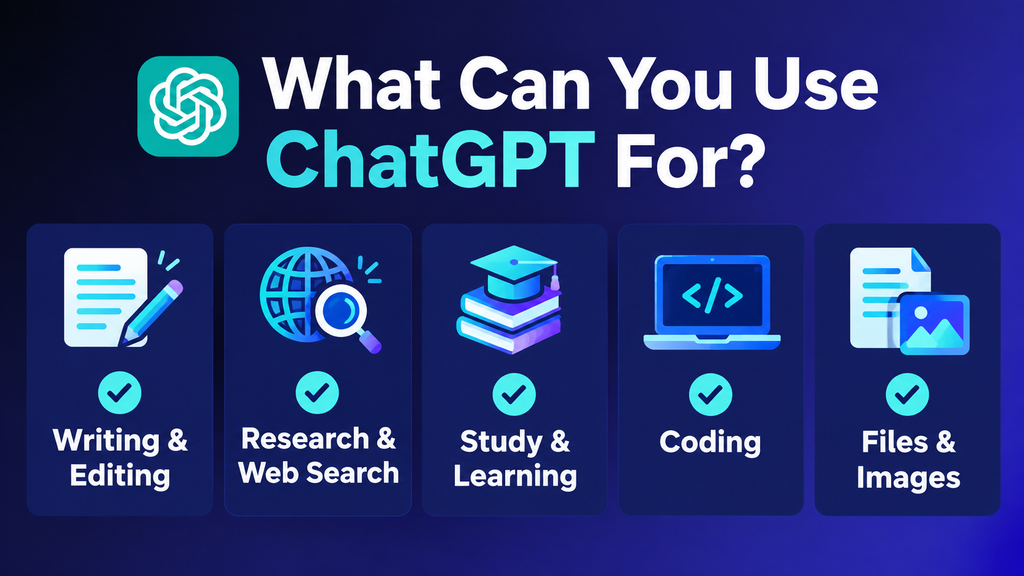
What Can You Use ChatGPT For?
ChatGPT can fit into a wide range of everyday and professional tasks. The usefulness depends largely on what you need it to do.
Writing and Editing
Writing is one of the simplest ways to use ChatGPT.
It can help create drafts, rewrite existing content, summarize information, brainstorm ideas, and adjust the tone of written material.
For example, you could provide a rough client email and ask ChatGPT to make it clearer and more professional while keeping the original meaning.
For bloggers and writers, it can also help with topic ideas, outlines, headlines, and editing.
The important part is what you do with the output afterward. Published content still needs fact-checking, editing, and useful information that actually helps the reader.
Research and Web Search
ChatGPT can search the web when current information is needed. This can be helpful when researching products, companies, current developments, or other subjects where information changes over time.
It can speed up the initial research process, but users should still check important information against the source.
This matters particularly when researching subjects such as pricing, business information, laws, finance, or technical specifications.
Studying and Learning
Students can use ChatGPT to explain difficult concepts, create practice questions, summarize material, or provide examples.
Instead of simply asking for an answer, a student can ask ChatGPT to explain why an answer is correct or quiz them on a particular subject.
That makes it more useful as a learning assistant rather than simply an answer generator.
Students should still make sure they understand the material themselves and follow any academic rules that apply to AI-assisted work.
Coding
ChatGPT can help with programming by explaining code, identifying possible problems, generating examples, and helping users understand programming concepts.
For beginners, being able to ask follow-up questions about the same piece of code can be particularly useful.
Developers should still test AI-generated code before using it in a real application. Generated code can contain errors or security problems.
File and Image Analysis
ChatGPT can work with supported files and images for analysis and other tasks.
This can be useful for documents, spreadsheets, screenshots, charts, and other information that might otherwise take time to review manually.
For example, instead of manually going through a long document to find a particular type of information, you can ask ChatGPT to summarize or organize the relevant material.
The exact capabilities and limits depend on the ChatGPT plan and current product availability.
Key ChatGPT Features
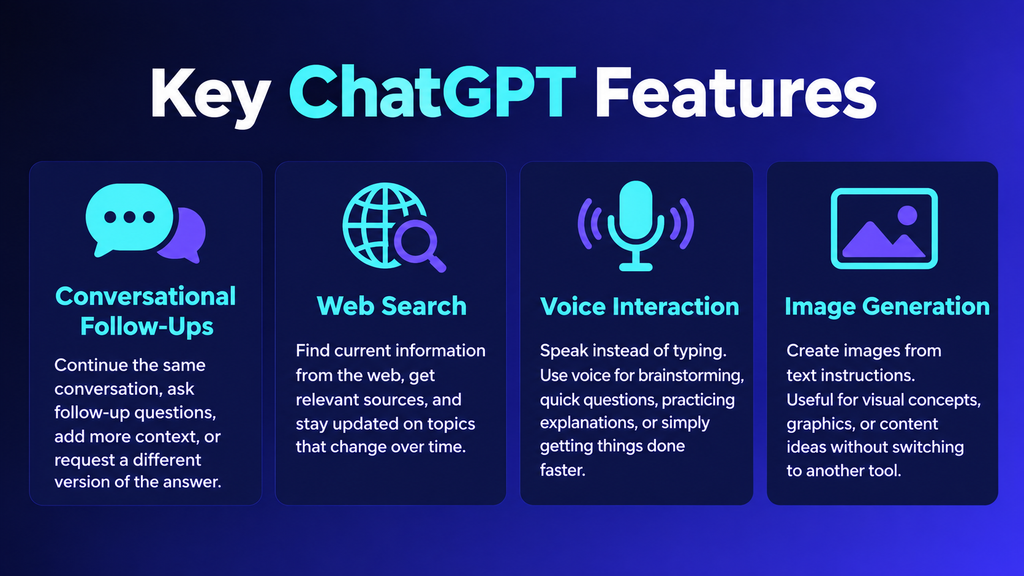
ChatGPT’s usefulness comes from having several capabilities available within one service.
Conversational Follow-Ups
You can continue a conversation instead of creating a completely new request every time.
If the first answer is too complicated, you can ask for a simpler explanation. If it is too long, you can ask for a shorter version.
You can also provide additional context and ask ChatGPT to adjust the answer.
That makes it easier to work through tasks gradually instead of trying to write one perfect prompt from the beginning.
Web Search
Web search allows ChatGPT to find current information rather than relying only on information from its underlying training.
This can be useful for current events, product information, research, and other topics that change regularly.
However, users should still check the sources before relying on important information.
Voice Interaction
ChatGPT also supports voice conversations, allowing users to communicate through speech instead of typing every request.
This can be convenient for brainstorming, asking quick questions, practicing explanations, or simply talking through an idea.
Image Generation
ChatGPT can also create images from text instructions.
This gives users another option for creating visual concepts and content without necessarily using a separate image-generation service.
Feature availability and usage limits can vary by plan, so it is worth checking the current OpenAI information if a particular feature is important to you.
ChatGPT Pricing and Plans
ChatGPT offers several plans with different levels of access and usage limits.
Because OpenAI can change pricing, features, and limits, it is a good idea to check the current official information before subscribing.
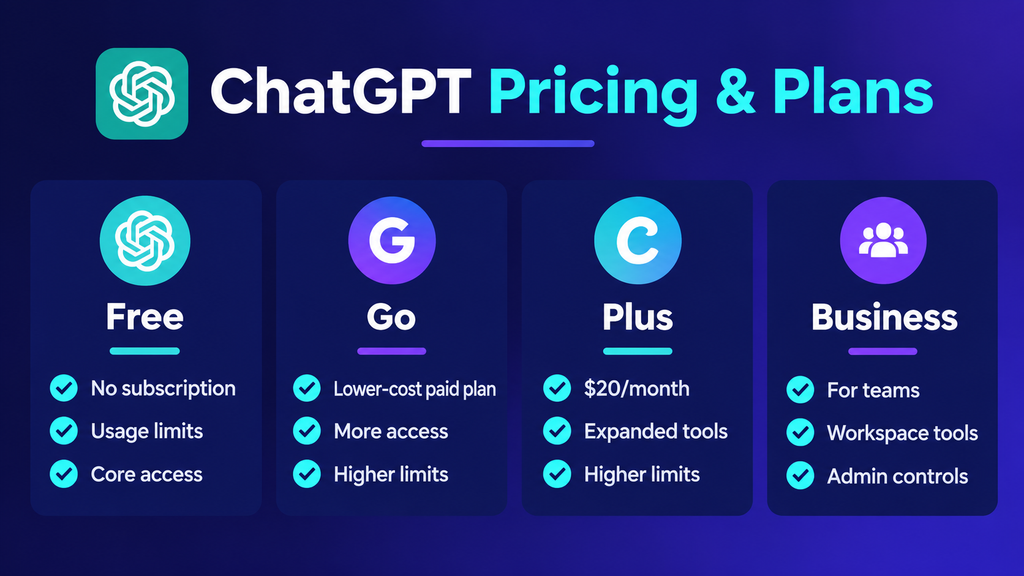
ChatGPT Free
The Free plan allows users to access ChatGPT without paying for a subscription.
It is suitable for people who want to try the service or use it occasionally.
There are limits on usage and access to some features, so people who use ChatGPT heavily may eventually need to consider a paid plan.
ChatGPT Go
ChatGPT Go is a lower-cost paid option introduced by OpenAI in 2026.
It provides more access to several ChatGPT capabilities than the Free plan.
Pricing and availability can vary by market, so users should check the price displayed for their location before subscribing.
ChatGPT Plus
ChatGPT Plus is designed for users who want more access to ChatGPT’s models and tools.
The standard price is currently $20 per month.
For someone who uses ChatGPT regularly for work, research, writing, study, or coding, the additional access may be useful.
Someone who only uses ChatGPT occasionally may find that the Free plan already meets their needs.
ChatGPT Business
ChatGPT Business is designed for organizations and teams rather than individual casual users.
It provides business-focused features such as workspace administration, collaboration, and organizational controls.
Businesses should compare the current plan details with their team size, usage requirements, privacy needs, and budget before choosing a plan.
ChatGPT Pros and Cons
No AI tool is perfect, and ChatGPT has both useful strengths and important limitations.
Pros of ChatGPT
- Easy to use
- Useful for many different types of tasks
- Helpful for writing, brainstorming, and learning
- Can search the web for current information
- Supports supported files and images
- Available through web and mobile apps
- Free access is available.
Cons of ChatGPT
- AI-generated information can be incorrect.
- Some responses can feel generic.
- Important information still needs verification.
- Usage limits vary between plans.
- Generated code requires testing and review.
- Some advanced capabilities require paid access.
The most important thing to remember is that a fluent answer is not necessarily a correct answer.
Is ChatGPT Safe and Trustworthy?
ChatGPT can be useful, but users should understand its limitations.
For ordinary tasks such as brainstorming or drafting, an incorrect detail may be easy to identify and fix.
The situation is different for important financial, legal, medical, technical, or business decisions. In those cases, relying on an AI response without verification can create unnecessary risks.
Privacy is another consideration.
Users should think carefully before entering confidential or sensitive information into any online AI service. Business users should also review the privacy and data policies associated with the specific plan they are using.
The safest approach is to use ChatGPT as an assistant while keeping human judgment involved in important decisions.
Who Should Use ChatGPT?
ChatGPT can be useful for several types of users.
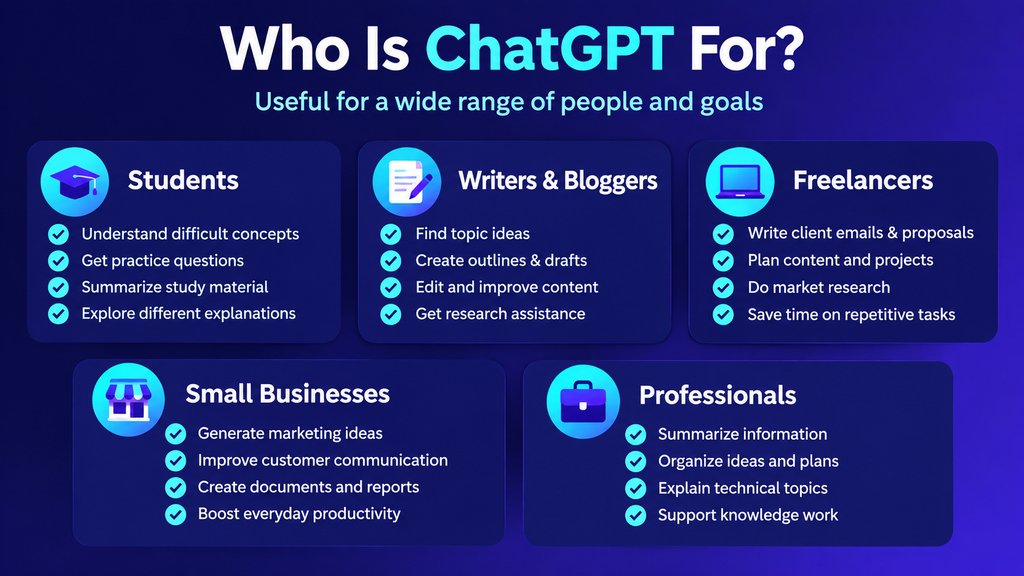
Students
Students can use it for explanations, revision, practice questions, and brainstorming.
It can be especially helpful when a concept needs to be explained differently.
Writers and Bloggers
Writers can use it for research assistance, outlines, brainstorming, editing, and first drafts.
However, published content should be reviewed, fact-checked, and improved with genuine research and useful information rather than simply publishing raw AI output.
Freelancers
Freelancers can use ChatGPT for client emails, proposals, content planning, research, and repetitive writing tasks.
It can also help turn rough ideas into a workable first draft, which can then be edited before sending it to a client.
Small Businesses
Small businesses can use ChatGPT for marketing ideas, customer communication, documentation, research, and everyday productivity.
It can also help business owners organize information or create initial versions of routine documents.
Professionals
Professionals can use ChatGPT to summarize information, organize ideas, explain technical subjects, and support different types of knowledge work.
The usefulness will naturally depend on the person’s role and workflow.
ChatGPT for Business
Businesses can use ChatGPT for much more than simple question answering.
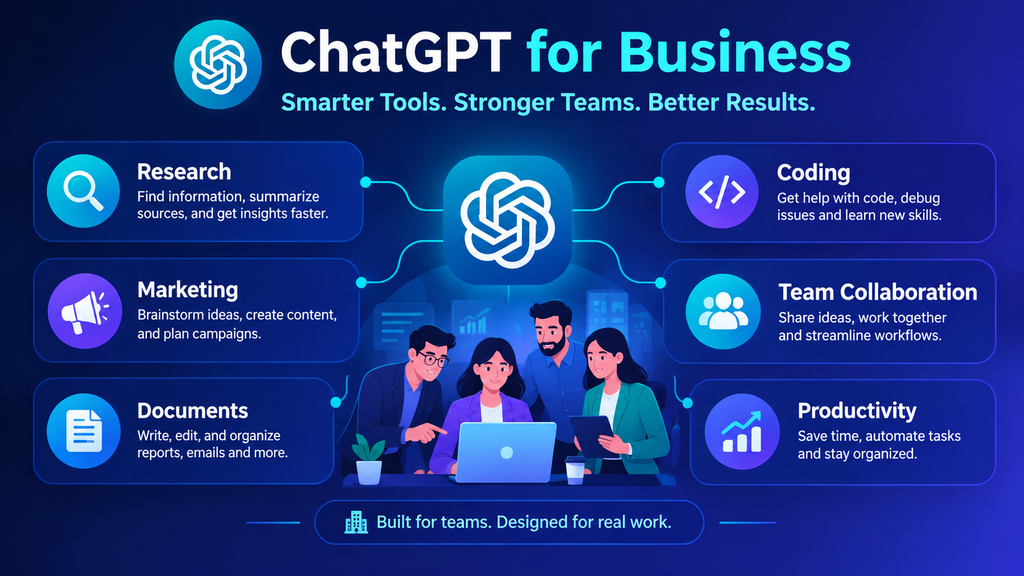
Common use cases include creating internal documents, brainstorming marketing campaigns, summarizing information, assisting with research, supporting coding workflows, and developing repeatable AI-assisted processes.
For teams, ChatGPT Business provides additional organizational and administrative capabilities compared with an individual account.
However, a business should consider its actual requirements before choosing a plan.
A freelancer working alone may have very different needs from a small marketing team or a larger organization.
We will cover this topic in more detail in our dedicated ChatGPT for Business guide.
ChatGPT Alternatives
ChatGPT is not the only AI assistant available today.
Depending on your requirements, you may also want to explore tools such as Claude, Google Gemini, Microsoft Copilot, and specialized AI applications.
When comparing AI tools, look beyond popularity. Consider the features that matter to your particular workflow.
Some useful comparison points include:
- Pricing
- Usage limits
- Writing quality
- Coding capabilities
- Web research
- File support
- Integrations
- Privacy controls
- Business features
Different tools can fit different workflows, so it makes sense to compare them based on what you actually need to accomplish.
Final Thoughts
ChatGPT has developed into a flexible AI assistant that can support writing, learning, research, coding, productivity, and business tasks.
Its biggest strength is versatility. The same tool can help with a simple email, explain a difficult concept, assist with research, or help organize a business task.
But ChatGPT is not a replacement for human judgment. Its responses can contain mistakes, and important information should be verified before it is used.
For occasional users, the Free plan provides a way to explore ChatGPT without paying for a subscription. People who use AI more frequently can compare the paid plans based on the features and usage limits they actually need.
The best way to evaluate ChatGPT is not by its feature list alone. Try it with the tasks you actually need to complete and see whether it genuinely saves you time or improves your workflow.
Frequently Asked Questions
Is ChatGPT free?
Yes. OpenAI offers a Free plan, although usage and access to some features are limited. Paid plans provide additional access and capabilities.
What is ChatGPT mainly used for?
ChatGPT is commonly used for writing, brainstorming, studying, research, coding, planning, file analysis, and other productivity tasks.
What are the disadvantages of ChatGPT?
ChatGPT can provide incorrect information, produce generic responses, and has usage limits that vary by plan. Important information should always be reviewed.
Is ChatGPT useful for students?
Yes. Students can use ChatGPT for explanations, revision, practice questions, and learning. It should support understanding rather than replace the student’s own work.
Can ChatGPT be used for business?
Yes. Individuals can use ChatGPT for everyday business tasks, while ChatGPT Business provides additional features designed for team and organizational use.
Can ChatGPT search the internet?
Yes. ChatGPT can search the web for current information and provide links to relevant sources.
Is ChatGPT good for blogging?
ChatGPT can help bloggers with brainstorming, outlines, research assistance, editing, and drafting. However, a strong published article should include original research, useful examples, fact-checking, and human editorial judgment rather than simply publishing raw AI output.