What Is the Future of Information Technology?
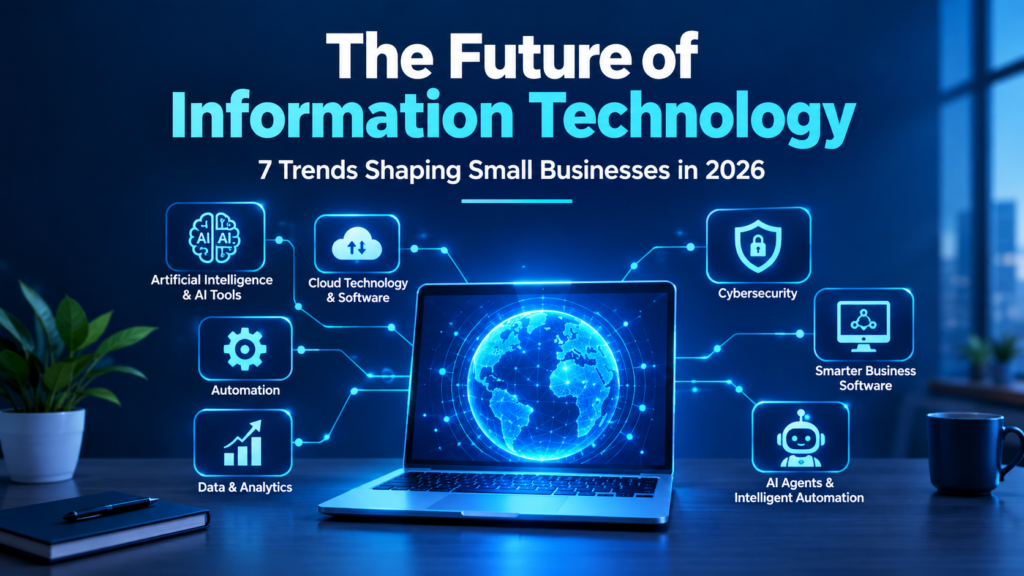
The future of information technology is moving toward smarter, more connected, and more automated business systems. Artificial intelligence, cloud computing, automation, data analytics, and cybersecurity are becoming increasingly important parts of everyday business operations.
For small businesses, this change is especially significant. Technologies that once required large budgets or specialist teams are now available through cloud-based software and subscription services. The practical question is no longer whether a business should use technology, but which technologies can solve real problems without adding unnecessary complexity.
In this guide, we’ll look at seven information technology trends shaping small businesses in 2026, how these technologies can solve common business problems, and practical steps businesses can take when adopting new technology.
Why Information Technology Matters for Small Businesses
Technology can help a small business compete, operate efficiently, and serve customers more effectively. The biggest benefits usually come when technology is connected to a specific business need rather than adopted simply because it is new.
Small businesses can use modern IT to:
- Automate repetitive administrative work
- Improve communication and collaboration
- Manage customer information more effectively
- Analyze sales and marketing data
- Support remote or hybrid work
- Protect business accounts and customer information
- Scale operations without investing heavily in physical infrastructure
The right technology does not replace good business decisions. Instead, it can give owners and teams better tools for making and carrying out those decisions.
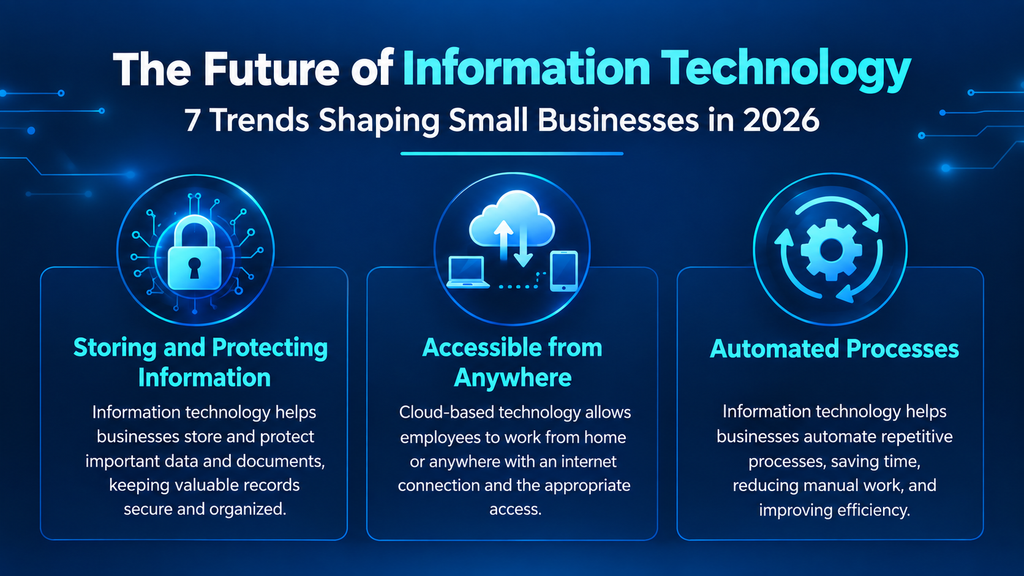
7 Technology Trends Shaping Small Businesses in 2026
1. Artificial Intelligence and AI-Powered Tools
Artificial intelligence is becoming part of many everyday business tools. Small businesses can use AI for customer support, content creation, data analysis, research, productivity, and other tasks.
Common examples include:
- AI chatbots and virtual assistants
- AI-assisted marketing and content creation
- Predictive or automated data analysis
- Image, voice, and text processing
- AI features built into business software
The most useful approach is to start with a specific task. For example, a business might use an AI assistant to draft customer responses or summarize information before introducing AI into more complex workflows.
2. Business Automation
Business automation helps reduce manual work by allowing software to perform repeatable tasks according to defined rules or workflows.
Small businesses can automate activities such as:
- Invoicing and payment reminders
- Email marketing
- Appointment scheduling
- Customer follow-ups
- Data entry
- Inventory updates
- Internal notifications
Automation can save time, but it should be designed carefully. Businesses should review automated workflows regularly to make sure errors do not spread across multiple systems.
3. Cloud Technology and Software
Cloud computing continues to shape how businesses store information, access software, and collaborate. Instead of relying entirely on computers or servers at one location, businesses can use online services that are accessible from different devices and locations.
Cloud-based software can support:
- Remote and hybrid work
- Real-time collaboration
- Online file storage
- Scalable computing resources
- Business applications delivered through SaaS platforms
For small businesses, cloud software can also make it easier to add or remove users and services as needs change. Businesses should still review security, backups, user permissions, and vendor reliability before moving important operations to a cloud service.
4. Data and Business Analytics
Businesses generate data through sales, websites, advertising, customer interactions, and other activities. Analytics tools can help turn that information into useful insights.
Small businesses can use analytics to:
- Understand customer behavior
- Monitor sales performance
- Identify effective marketing channels
- Compare products or services
- Track business trends
- Find areas where costs can be reduced
Modern analytics platforms can make basic reporting accessible without requiring a dedicated data science team. The important step is to focus on useful questions rather than collecting data simply because it is available.
5. Cybersecurity and Business Protection
As more business activity moves online, protecting accounts, systems, and customer information becomes increasingly important. Cybersecurity is not only a concern for large organizations; small businesses can also be affected by phishing, stolen credentials, malware, ransomware, and other attacks.
Important security practices include:
- Multi-factor authentication
- Strong and unique passwords
- Regular software updates
- Secure backups
- Employee security training
- Access controls and user permissions
- Protection against phishing and malicious files
Cybersecurity should be treated as an ongoing business process rather than a one-time software purchase.
6. Smarter Business Software and New Technology Systems
Business software is increasingly combining multiple capabilities in one platform. CRM, project management, communication, accounting, marketing, and other systems can now include automation, analytics, and AI-assisted features.
Examples include:
- CRM systems with automated follow-ups and AI-assisted insights
- Project management platforms with workflow automation
- Accounting software with automated reporting
- Collaboration platforms that connect communication and file sharing
- Business systems that connect data across different departments
The advantage of connected systems is that businesses can reduce repetitive data entry and create more consistent workflows. The challenge is choosing tools that integrate well instead of creating a collection of disconnected applications.
7. AI Agents and More Intelligent Automation
AI agents are an emerging area of business technology. Unlike simple rule-based automation, an AI agent can be designed to interpret information, use connected tools, and complete a sequence of tasks with less step-by-step direction.
Potential business uses include:
- Handling routine customer-support tasks
- Organizing information
- Assisting with research
- Supporting sales or lead-management workflows
- Coordinating repetitive digital tasks
Because this technology is developing quickly, businesses should evaluate accuracy, permissions, security, human oversight, and the specific tasks an agent is allowed to perform. For important business decisions, human review should remain part of the workflow.
How New Technology Systems Can Help Small Businesses
New technology is most useful when it solves a clearly defined business problem. Instead of asking which tool is popular, start by asking where the business is losing time, money, information, or opportunities.
Here are some examples:
- Too much manual work: Consider workflow automation.
- Customer follow-ups are missed: Consider a CRM with automated reminders.
- Teams struggle to collaborate: Consider cloud-based collaboration software.
- Business data is difficult to understand: Consider analytics and reporting tools.
- Security practices are inconsistent: Improve account protection, permissions, backups, and staff training.
- Software systems do not communicate: Look for integrations or a more connected technology stack.
What Are the Benefits of Future Technology for Small Businesses?
The benefits depend on how well a technology matches the business need. Common benefits can include:
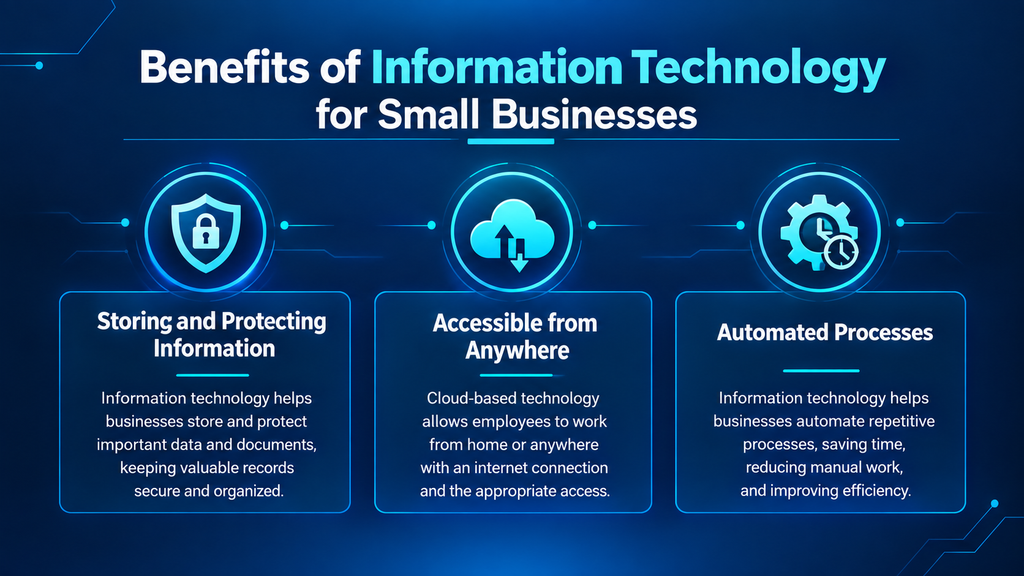
- Increased efficiency through automation
- Lower operational costs in suitable workflows
- Better customer experiences
- Faster access to business information
- More consistent processes
- Easier collaboration
- Greater scalability
- Stronger security practices
Technology should not be adopted simply to appear modern. A useful technology investment should have a clear purpose and a way to measure whether it is helping.
Challenges of Adopting New Technology
Technology adoption also creates challenges. Small businesses may face:
- Upfront or ongoing costs
- Limited technical expertise
- Employee resistance to new workflows
- Integration problems between tools
- Data and cybersecurity risks
- Time required for setup and training
- Dependence on third-party software providers
These challenges can often be reduced by starting with one problem, testing a solution on a small scale, training users, and reviewing the results before expanding.
How Small Businesses Can Prepare for the Future of IT
Small businesses do not need to adopt every new technology. A practical technology strategy can begin with the following steps:
- Identify business problems and repetitive tasks.
- Set a clear goal for each technology investment.
- Start with one or two high-value improvements.
- Compare features, pricing, integrations, and security before choosing a tool.
- Train employees before changing important workflows.
- Protect accounts and business data from the beginning.
- Review performance and costs regularly.
- Replace tools that no longer provide enough value.
This approach allows a business to adopt technology gradually instead of making too many changes at once.
What Will the Future of Information Technology Look Like?
The future of IT will likely involve more AI-assisted work, connected cloud services, automation, real-time analytics, and security built into everyday business systems.
Businesses may also see more software capable of completing multi-step tasks with limited human input. At the same time, human judgment will remain important for strategy, customer relationships, creative work, risk management, and decisions that require context.
The businesses that benefit most from new technology will not necessarily be the ones using the most tools. They will be the ones that choose appropriate technology, implement it carefully, and continue measuring its real-world value.
Frequently Asked Questions
What is the future of information technology?
The future of information technology is increasingly focused on artificial intelligence, automation, cloud computing, analytics, connected software, and cybersecurity. These technologies are changing how businesses work and make decisions.
What is the future of IT in business?
IT is becoming more closely integrated with everyday business operations. Businesses can use technology for communication, customer management, automation, analytics, security, and many other functions.
How does technology help small businesses?
Technology can help small businesses save time, organize information, improve customer service, automate repetitive tasks, analyze data, and operate more efficiently.
What are the biggest technology trends in 2026?
Major trends include AI-powered tools, business automation, cloud technology, data analytics, cybersecurity, smarter business software, and emerging AI-agent workflows.
How can technology solve business problems?
Technology can solve specific business problems by automating repetitive tasks, organizing customer information, improving communication, providing analytics, and strengthening security.
What are new technology systems?
New technology systems are increasingly connected business platforms that combine capabilities such as automation, analytics, AI, communication, and customer or operational management.
How can small businesses adopt new technology?
Small businesses can start by identifying a specific problem, choosing a suitable solution, testing it on a small scale, training employees, and reviewing the results before expanding.
Why is cybersecurity important for small businesses?
Cybersecurity helps protect business accounts, systems, customer information, and operations from threats such as phishing, malware, ransomware, and unauthorized access.
Final Thoughts
The future of information technology is not only about adopting the newest tools. For small businesses, the real opportunity is using technology to solve practical problems, reduce unnecessary work, understand data, serve customers, and protect the business.
AI, automation, cloud software, analytics, cybersecurity, connected business systems, and AI-agent technology are all shaping the way businesses operate in 2026.
The best starting point is simple: identify one business problem, choose a technology that directly addresses it, implement it carefully, and measure the result. As technology continues to change, this problem-first approach can help small businesses adopt new tools without losing sight of what actually matters—their customers, their people, and their business goals.